The five elements: a plain guide to wu xing
Wood, fire, earth, metal and water are less five substances than five ways of changing. A plain guide to the cycles, the colors and the stones matched to them.
6 min read
The Book of Documents, one of the oldest Chinese classics, has a chapter called the “Great Plan.” The first of its nine headings is a list of five things, each introduced by what it does. In plain paraphrase: water soaks and sinks. Fire blazes and rises. Wood bends and straightens. Metal yields and can be recast. Earth takes seed and gives a harvest.
Tradition places the chapter at the founding of the Zhou dynasty, around the eleventh century BCE. Many scholars date the text some centuries later. Either way it is usually cited as the earliest list of the five, and it already shows the habit of mind that matters. Nothing in it is described as an ingredient. Each thing is described as a behavior.
The Chinese name is wǔxíng. The first syllable is “five.” The second, xíng, means to walk, to move, to act. English settled long ago on “the five elements,” and the phrase is too familiar to dislodge, but many scholars now prefer “five phases” or “five agents.” Our glossary entry on wu xing gives the short version. This is the longer one.
What wu xing means
The Greek elements of earth, water, air and fire were proposed as an answer to the question of what things are made of. The five phases answer a different question: how things change. Wood is growth, the push outward in spring. Fire is the peak: heat, brightness, full leaf. Earth is ripening and the steady middle. Metal is gathering in, the harvest cut and stored. Water is rest, the seed kept through winter.
The idea was worked into a system late in the Warring States period. A thinker of the third century BCE, Zou Yan, is traditionally credited with joining the five phases to yin and yang and using them to explain the rise and fall of dynasties. His own writings are lost, so the credit rests on later reports.
By the Han dynasty (206 BCE–220 CE) the five had become a general filing system. Seasons, directions, colors, flavors, musical notes, organs of the body and the visible planets were each sorted under one phase or another.
The generating and controlling cycles
What makes the scheme more than a list is the way the five are tied together. Two cycles do the work.
The first is xiāngshēng, mutual generation. Wood feeds fire. Fire leaves ash, which becomes earth. Earth bears metal, as ore in the ground. Metal gives rise to water. This is the step that puzzles most readers, and commentators have explained it as dew gathering on cold metal, or as metal running liquid in the furnace. Water nourishes wood, and the circle closes.
The second is xiāngkè, mutual overcoming, often called the controlling cycle. Wood breaks earth, as roots do. Earth dams water. Water puts out fire. Fire melts metal. Metal cuts wood. Drawn on paper, the generating cycle is a circle through five points and the controlling cycle is the five-pointed star inside it.
Put the two together and every phase stands in four relationships. Something feeds it and something restrains it; it feeds one neighbor and restrains another. The scheme has no strongest member, only an order that holds while every part is both fed and held back. It is the logic of yin and yang, worked out in five parts instead of two.
Colors, seasons and directions of the five elements
By the Han dynasty each phase had been given a color, a season and a direction, and the set has changed little since. It is listed below. Two entries need a note. The color of wood is qīng, the color of growing plants, a word that covers both green and blue. And earth sits at the center with no settled season: one tradition gives it a “long summer” between summer and autumn, another the closing days of all four seasons.
The same sorting reached the sky. The five planets visible to the naked eye still carry the names in Chinese: Jupiter is the wood star, Mars the fire star, Saturn the earth star, Venus the metal star, Mercury the water star. In Japanese the weekdays from Tuesday to Saturday are named after them.
- Wood: green, spring, the east.
- Fire: red, summer, the south.
- Earth: yellow, the center.
- Metal: white, autumn, the west.
- Water: black, winter, the north.
Which stones match each element
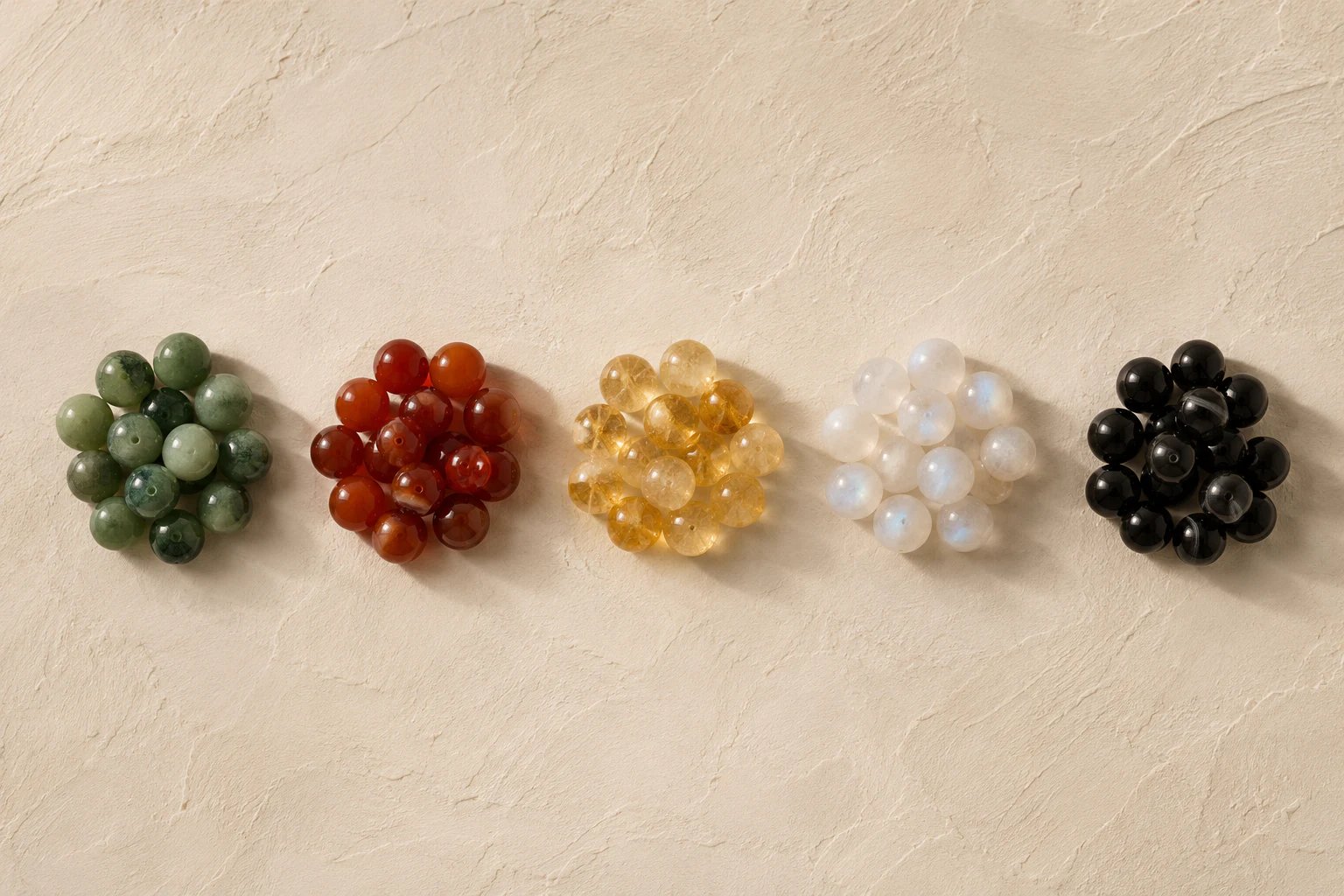
The honest answer is that the old correspondence is with color, not with any species of stone. The Rites of Zhou, a classical text on ritual, has jades offered by color: green to the east, red to the south, white to the west, black to the north, yellow to the earth. The lists of gemstones by element that circulate today are recent, and they do not agree with one another. Some feng shui practitioners count every stone as earth, since it comes out of the ground. Most jewelers follow color.
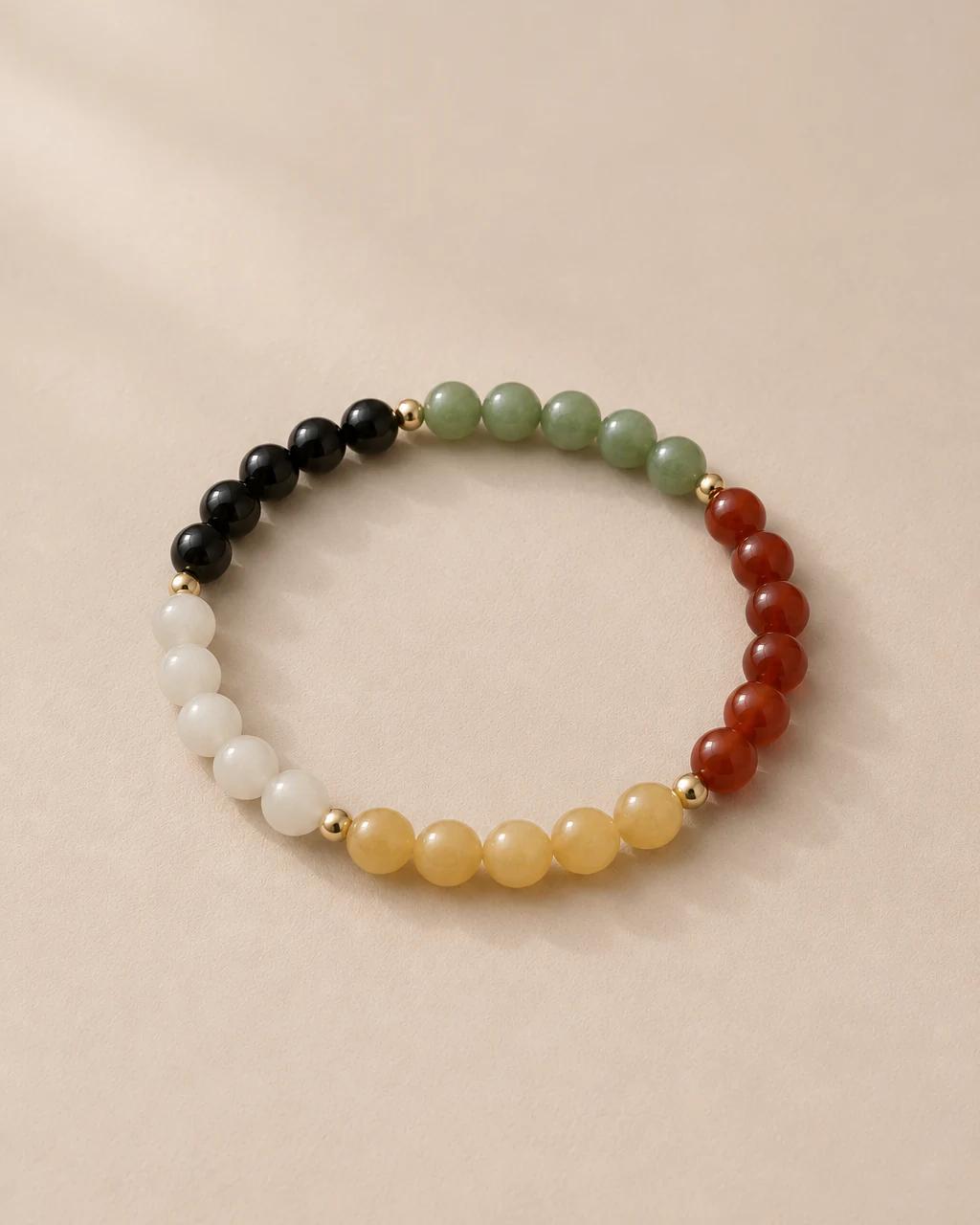
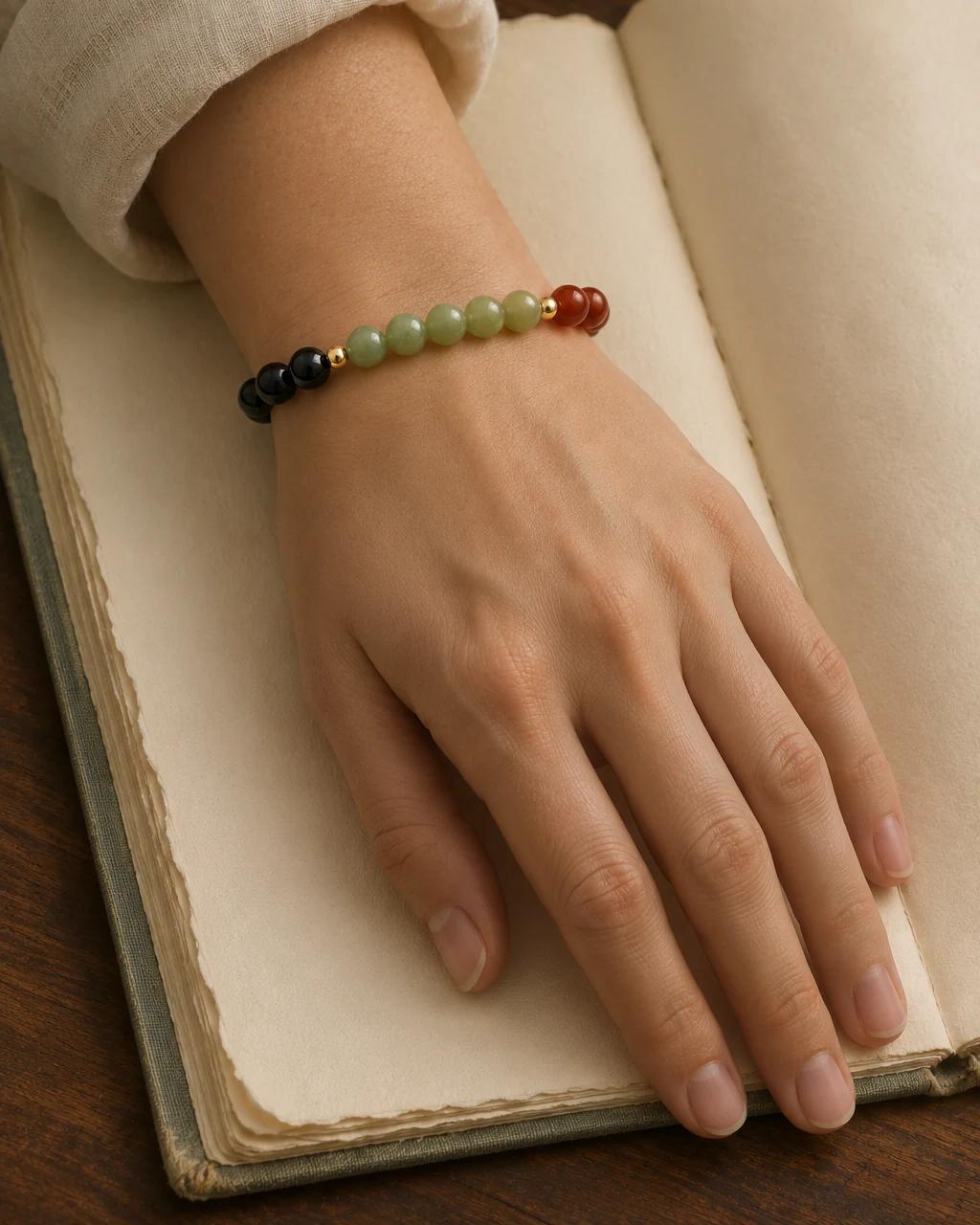
We follow color as well. The Wu Xing Bracelet strings five groups of 6mm beads in the generating order: green aventurine for wood, red carnelian for fire, honey-yellow jade for earth, white jade for metal and black obsidian for water. Because a bracelet is a circle, the black of water ends beside the green of wood, and the cycle closes on the wrist as it does on paper.
How the five elements are used today
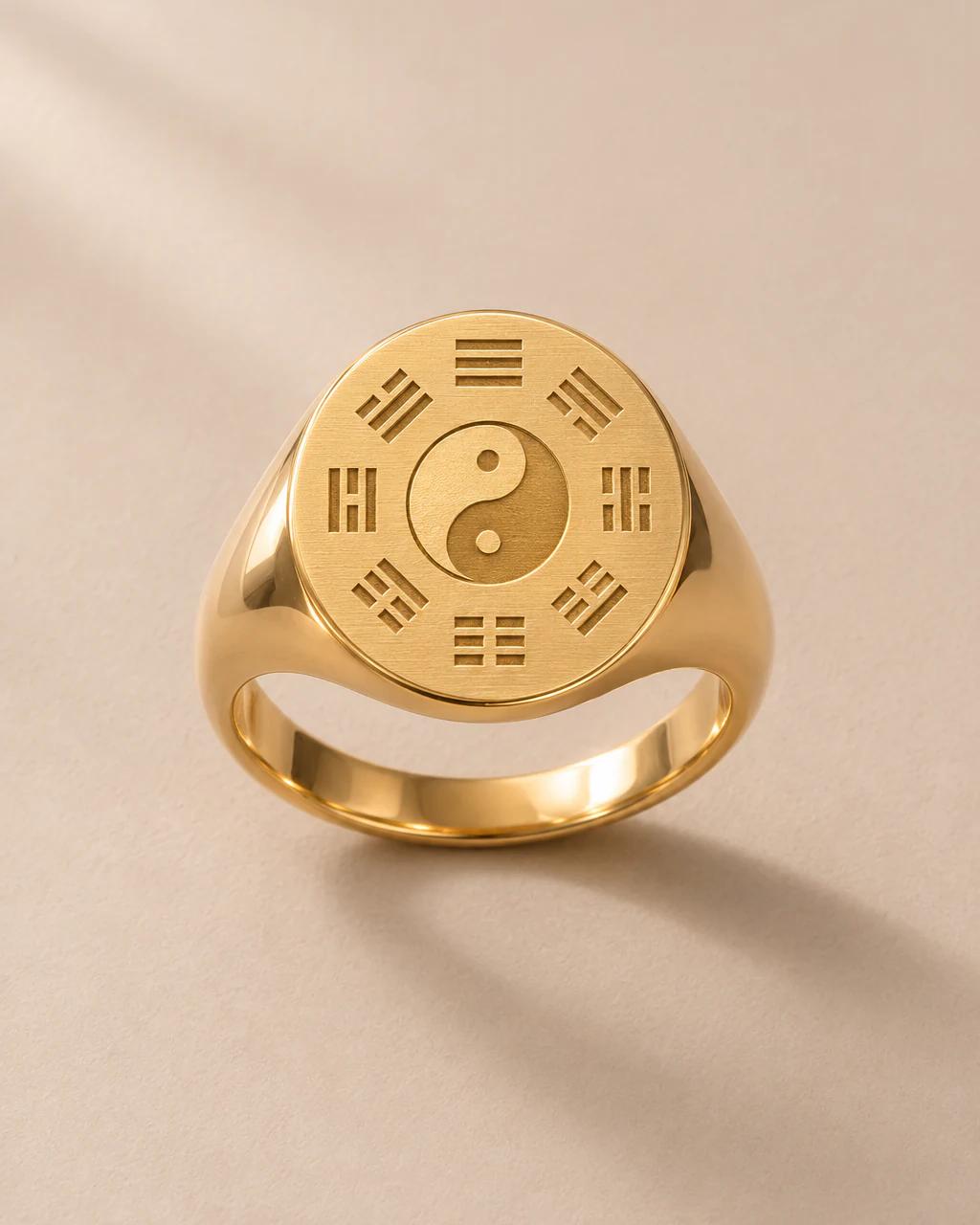
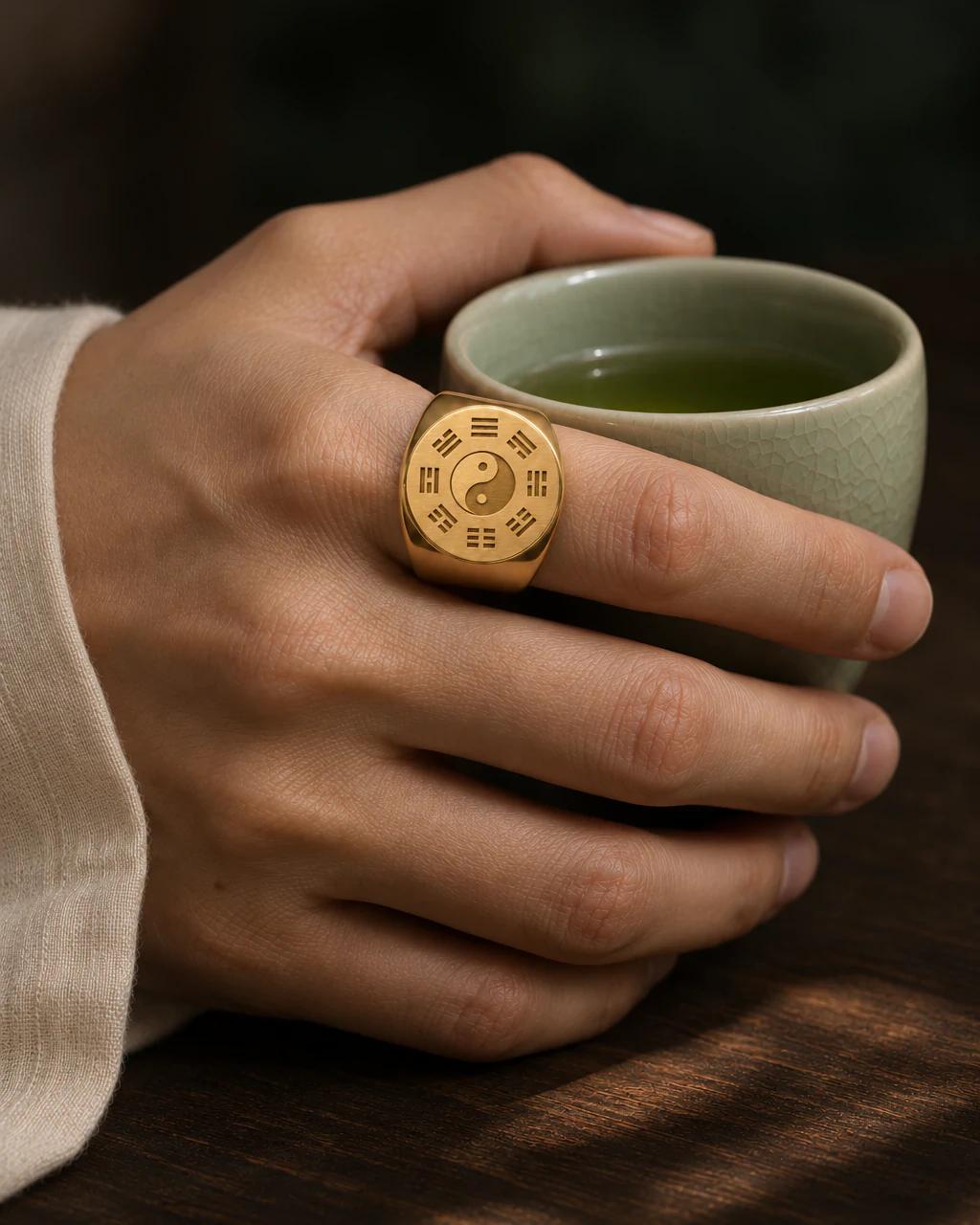
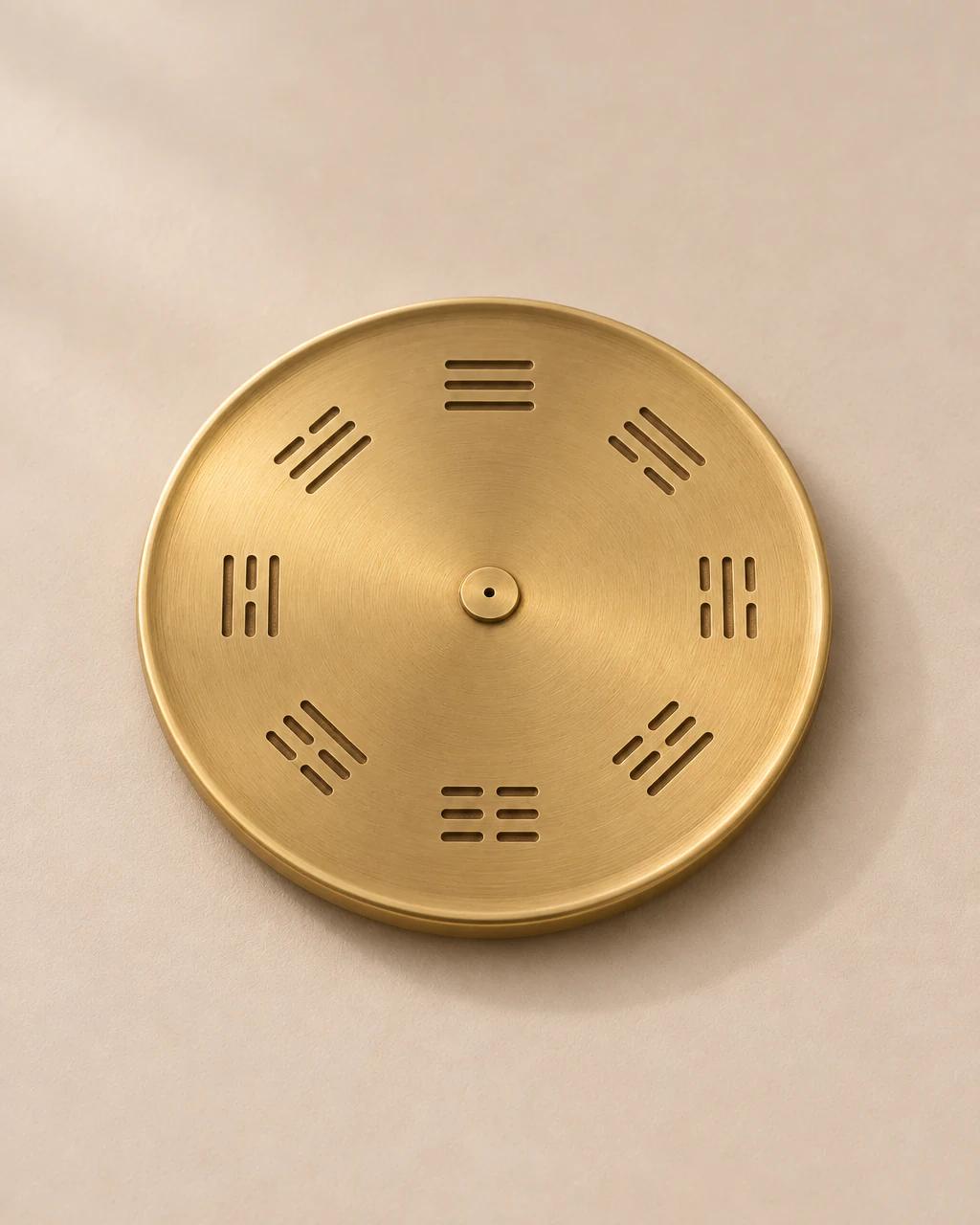
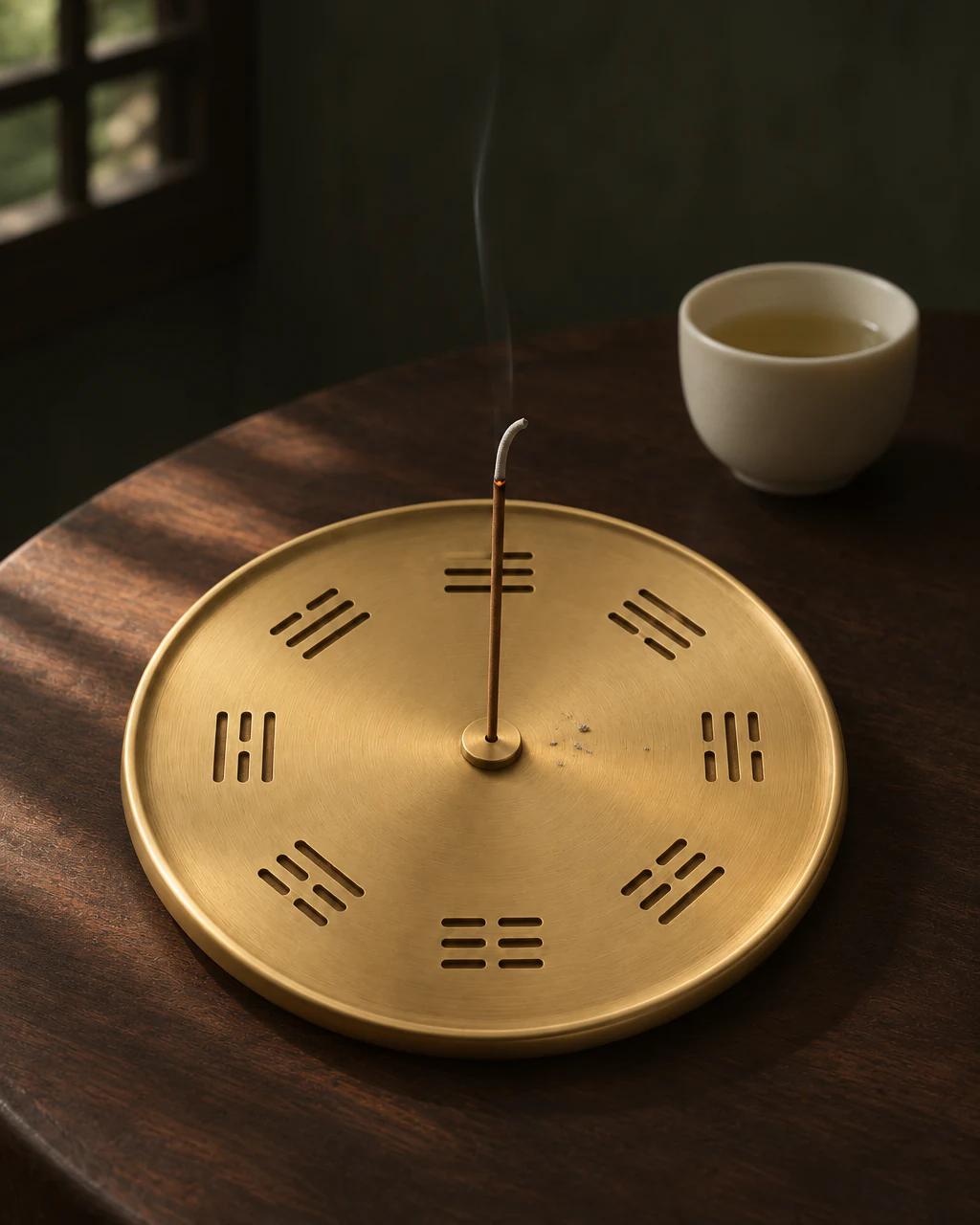
The five phases are still in daily use. Traditional Chinese medicine files the organs under them: liver with wood, heart with fire, spleen with earth, lungs with metal, kidneys with water. Feng shui reads rooms and directions by them, alongside the eight trigrams of the bagua. In the arrangement used for reading directions, the trigram for fire sits to the south and the trigram for water to the north. Two pieces in our Tao collection carry the trigrams, the Bagua Signet Ring and the brass Bagua Incense Plate, and they come out of the same family of ideas.
The most personal use is the birth chart. In bāzì, “eight characters,” the year, month, day and hour of a birth are each written with two characters, and every character belongs to a phase. A reader counts them up and says which phase is plentiful and which is scarce. Many families have named children to make up a shortfall. In Lu Xun’s 1921 story “My Old Home,” a village boy is named Rùntǔ, “leap-month earth,” because he was born in a leap month and his five phases lacked earth. Choosing a color or a stone for a scarce phase is the same custom in a lighter form.
We do not offer any of this as a tested claim about bodies or fortunes. What the five phases give is a vocabulary: a way to say that growth needs rest, that heat needs something to hold it, that nothing stays at its peak. People have found that worth keeping for more than two thousand years. Five colors on a cord are a compact way to keep it in view.
Filed under Wisdom6 min read