Yin and yang: what the taiji actually means
Yin and yang began as the shaded and sunlit sides of a hill. Where the taiji diagram comes from, how to read its parts, and why it does not mean good against evil.
6 min read
Take a hill on a clear morning. The slope that faces the sun is warm and already dry. The slope behind it is cool, and the dew is still on the grass. By late afternoon the light has moved and the two sides have begun to trade places. It is the same hill throughout.
That is yin and yang in their oldest sense. The words yīn and yáng began as names for shade and sun on a hillside: the dark slope and the bright one. In the Book of Songs, the earliest anthology of Chinese poetry, a leader settling his people climbs a ridge to survey the land’s yin and yang: where the shade falls and where the light does. There is no philosophy in it yet. It is a farmer’s observation.
Everything the symbol later came to mean grows from that hillside: two conditions that depend on each other, that are defined only by comparison, and that change places as the day goes on. The black and white circle known as the taiji is a much later drawing of the same thought.
What yin and yang mean
Beginning in the Warring States period, roughly the fifth to third centuries BCE, Chinese thinkers stretched the two words to cover every kind of change. Night and day, winter and summer, rest and movement, cold and heat, moon and sun: each pair was read as yin and yang. The Great Commentary on the Book of Changes, compiled late in that era or soon after, puts it in a single line: “One yin, one yang: this is called the Way.”
The Dao De Jing names the pair only once, in chapter 42. The ten thousand things, it says, carry yin on their backs and hold yang in their arms, and find their harmony where the two blend.
Two points matter more than any table of correspondences. First, yin and yang are relative terms, not substances. Nothing is yin by itself. Dusk is yin beside noon and yang beside midnight; a valley is yin to the ridge above it. Second, the pair describes a process. Yang at its height is already turning toward yin, as the longest day of the year is also the day the light begins to shorten.
Yin and yang are not good and evil
Western readers often meet the symbol as light against darkness and assume a contest: a good half and a bad half, with one meant to win. Classical Chinese thought does not read it that way. Yin is not evil, and it is not the lesser part. It is shade, coolness, stillness, the inward and the receptive. Yang is light, warmth, motion, the outward and the active. A day needs its night. A breath out needs a breath in.
The record is not spotless. Han dynasty scholars, Dong Zhongshu the best known among them, ranked yang above yin and used the pair to justify the hierarchies of court and household: ruler over subject, husband over wife. Yin is conventionally paired with the feminine and yang with the masculine, but as qualities, not as people. In this way of thinking every person holds both.
In the older and more durable reading, trouble is not yin or yang but too much of either, held for too long. A drought and a flood are faults of the same kind, and traditional Chinese medicine describes illness in similar terms, as the two fallen out of proportion. The aim is never victory, only proportion, adjusted as conditions change.
Where the yin-yang symbol comes from
The idea is older than the picture by well over a thousand years. The word tàijí, “the supreme ultimate”, comes from the same commentary on the Book of Changes: the taiji gives rise to two modes, the two to four images, and the four to the eight trigrams of the bagua. It is usually read as the undivided whole from which yin and yang separate. The second syllable, jí, originally meant the ridgepole of a roof, the highest beam, with a slope falling away on either side.
In the eleventh century the Song dynasty philosopher Zhou Dunyi wrote a short essay, the Explanation of the Diagram of the Supreme Ultimate. His diagram is not the one on a pendant. It is a vertical sequence of circles and lines, one circle banded in black and white, tracing how the one becomes the many.
The swirling circle came later, and its origin is uncertain. One tradition credits it to Chen Tuan, a Taoist recluse of the tenth century, but nothing survives from his hand to confirm it. The earliest examples that can be dated with any confidence are in books of the Ming dynasty, from the late fourteenth century on. In Chinese it is often called “the yin-yang fish”, for the two shapes that seem to follow each other around the circle.
How to read the taiji symbol
Zhou Dunyi’s essay states the rule the drawing illustrates: movement at its limit becomes stillness, and stillness at its limit returns to movement. The figure has four parts, and each carries a piece of that argument.
- The circle. The outer ring is the whole, the taiji itself. Yin and yang are divisions inside one thing, not two things set side by side.
- The two fields. Black is yin and white is yang. They are equal in area, and neither stays on top, because the figure is meant to be read as turning.
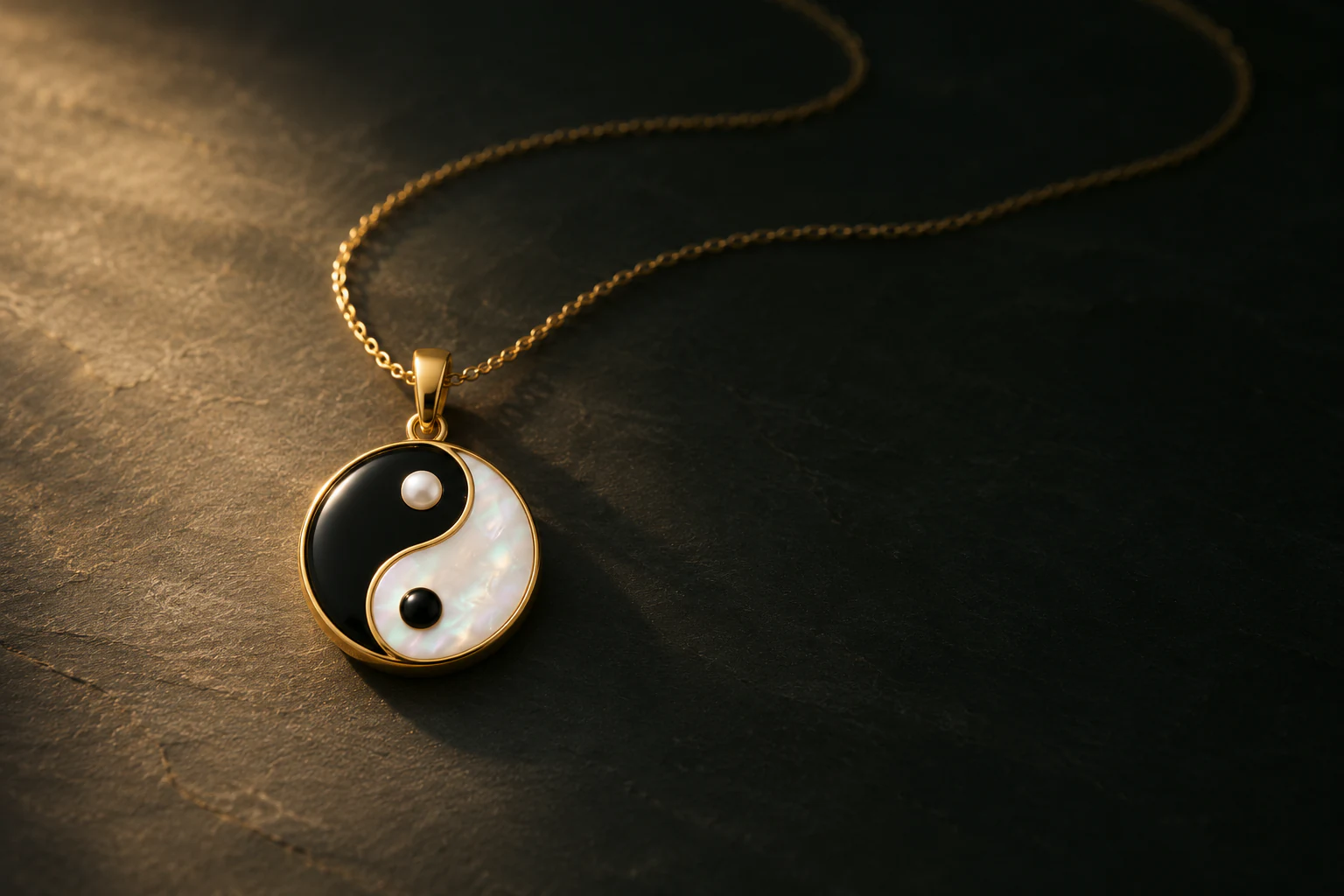
- The S-curve. A straight line would make two fixed halves. The curve lets each field swell as the other thins, the way daylight lengthens toward midsummer and gives way toward midwinter.
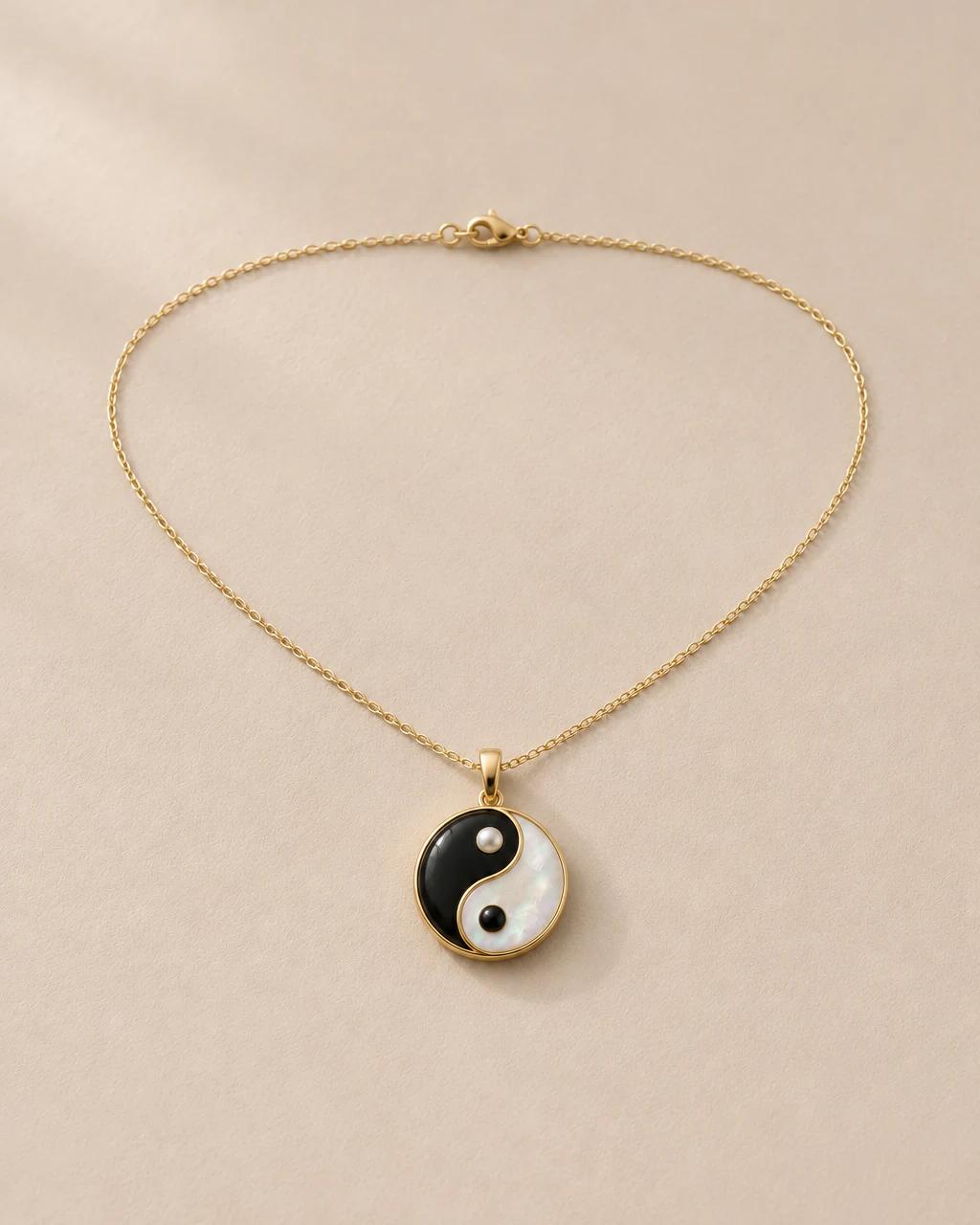
- The two seeds. Each field holds a dot of the opposite color where it is fullest. Yin already contains the beginning of yang, and yang the beginning of yin.
What wearing a yin-yang symbol has meant
Long before it was jewelry, the taiji was embroidered on the vestments of Taoist priests and carved in temples. In feng shui practice it sits at the center of the eight trigrams on the plaques hung above a door to turn ill fortune away. The martial art tàijíquán, tai chi, takes its name from it, and a red and blue form stands at the center of the South Korean flag.
In the West it became a common sight in the later twentieth century. Many who wear it describe it as a reminder, not a charm: that a hard season turns, that rest is part of work, that a firm opinion has a blind side. Traditionally it stands for balance and for the acceptance of change. It promises nothing, which may be part of why it has lasted.
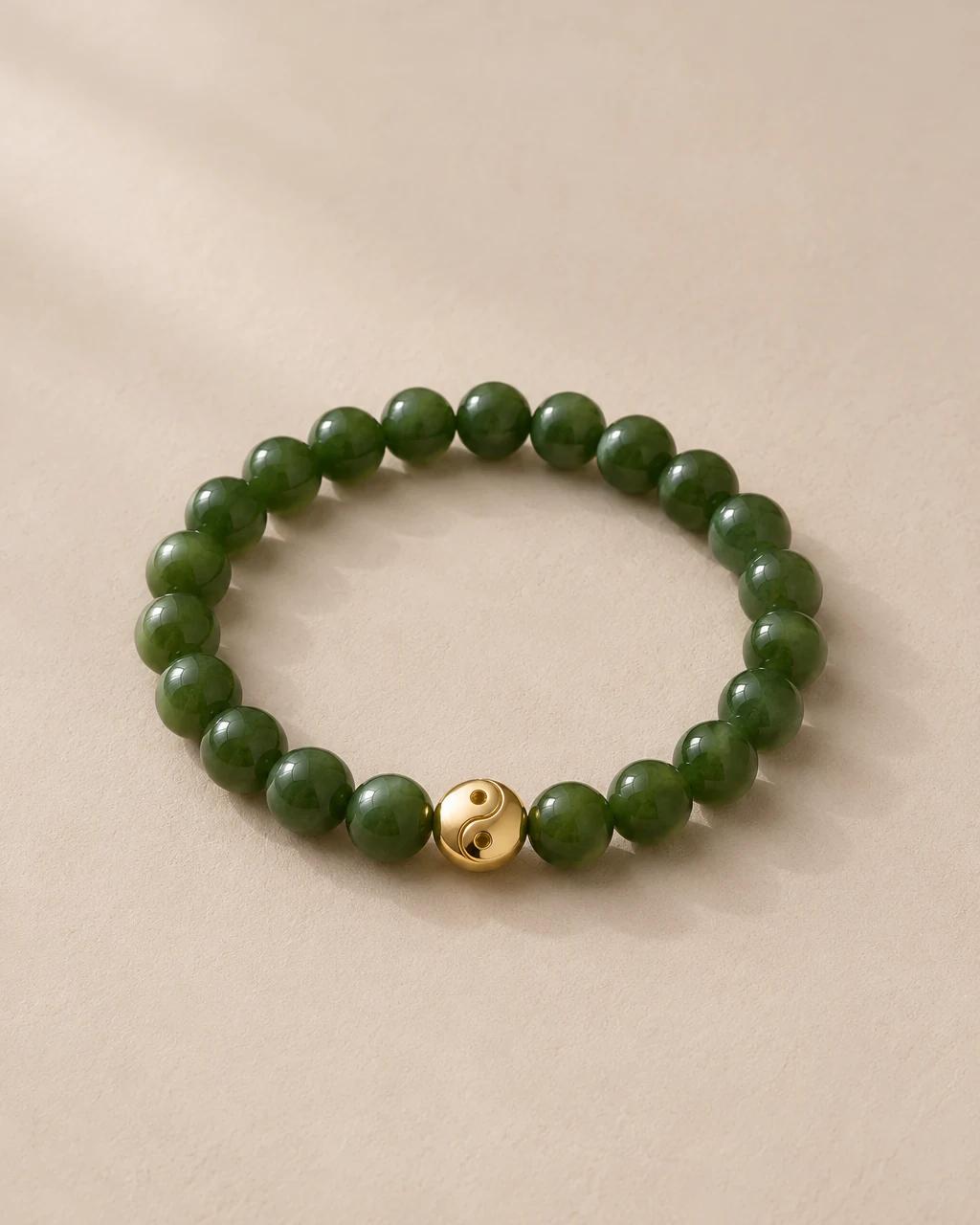
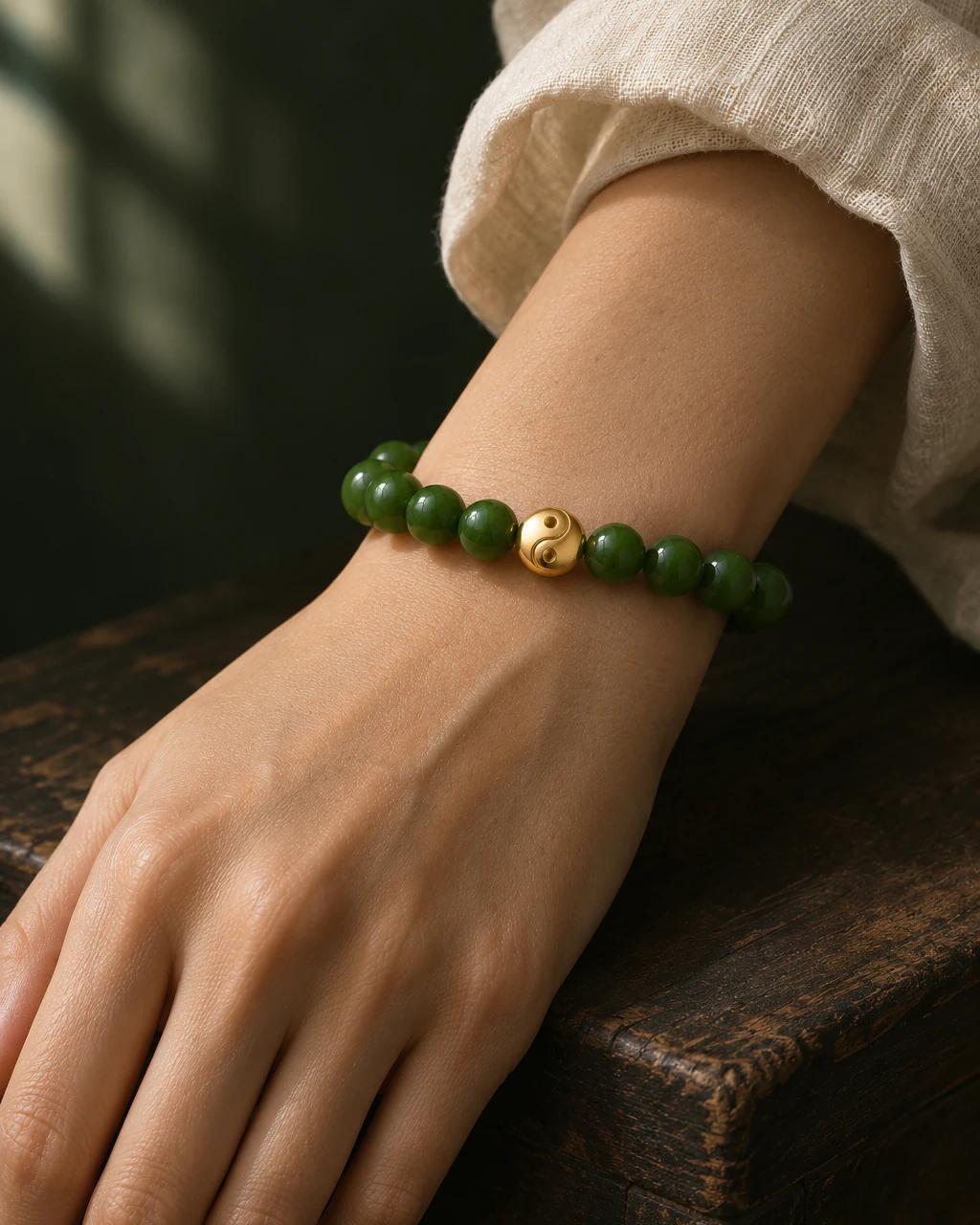
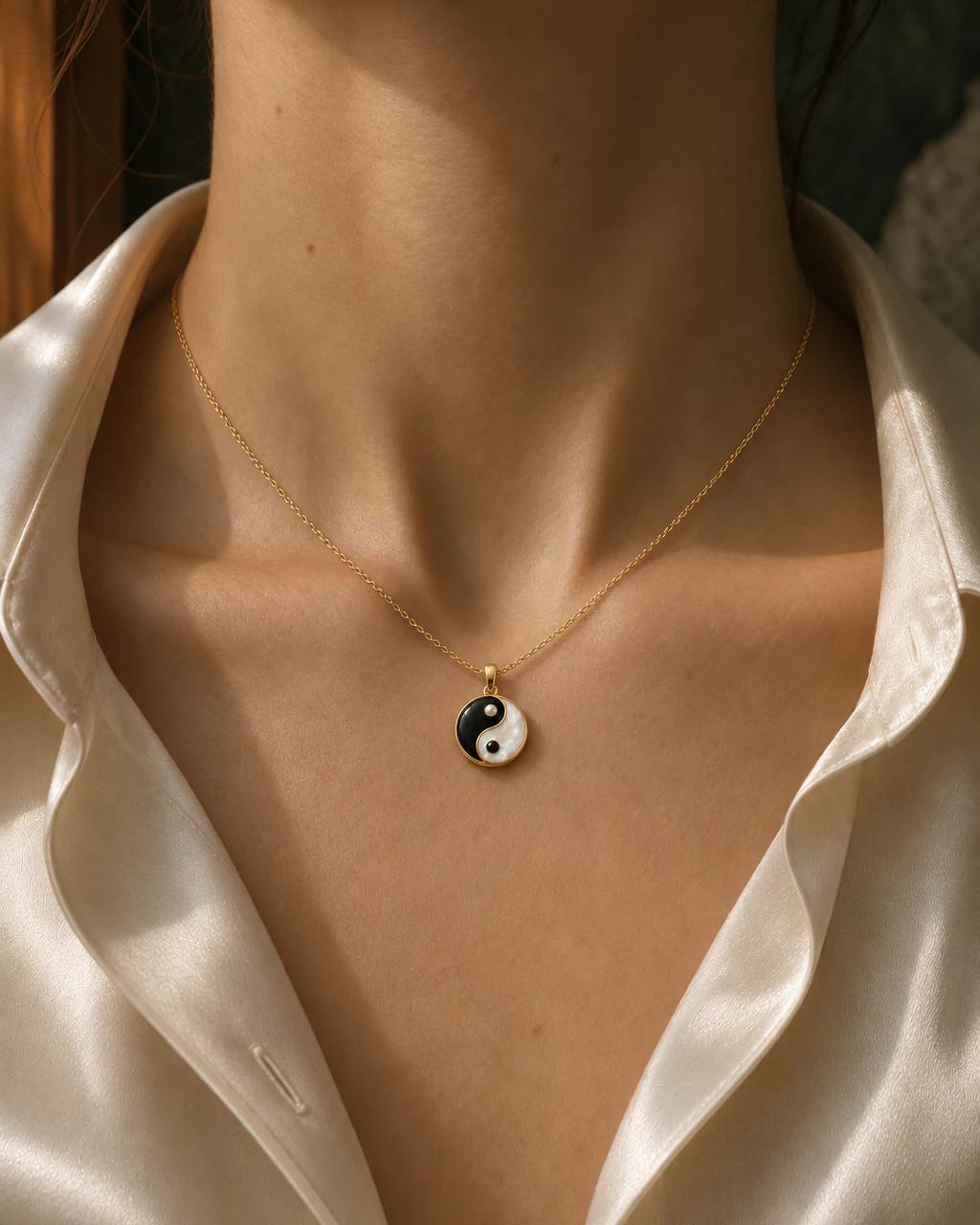
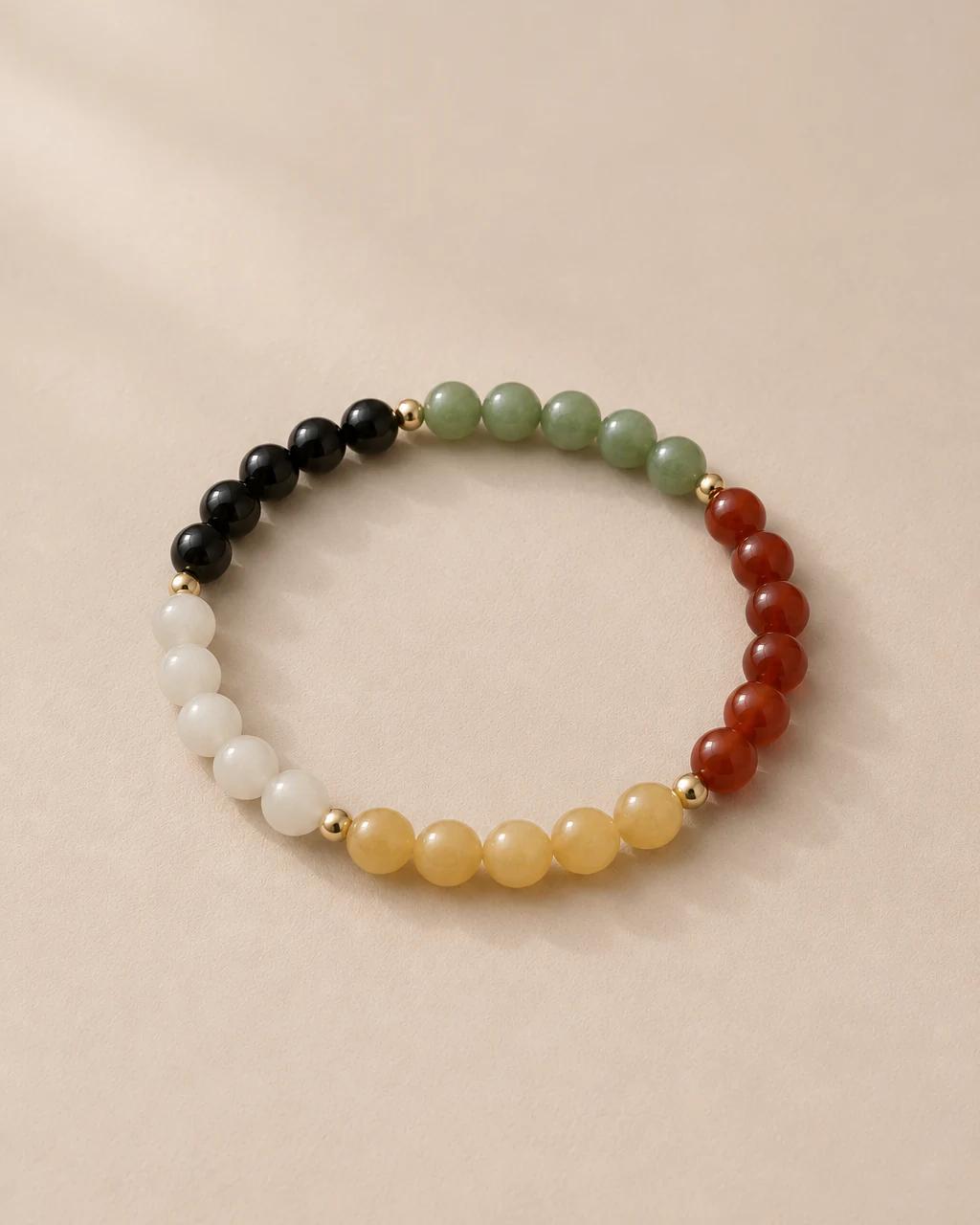
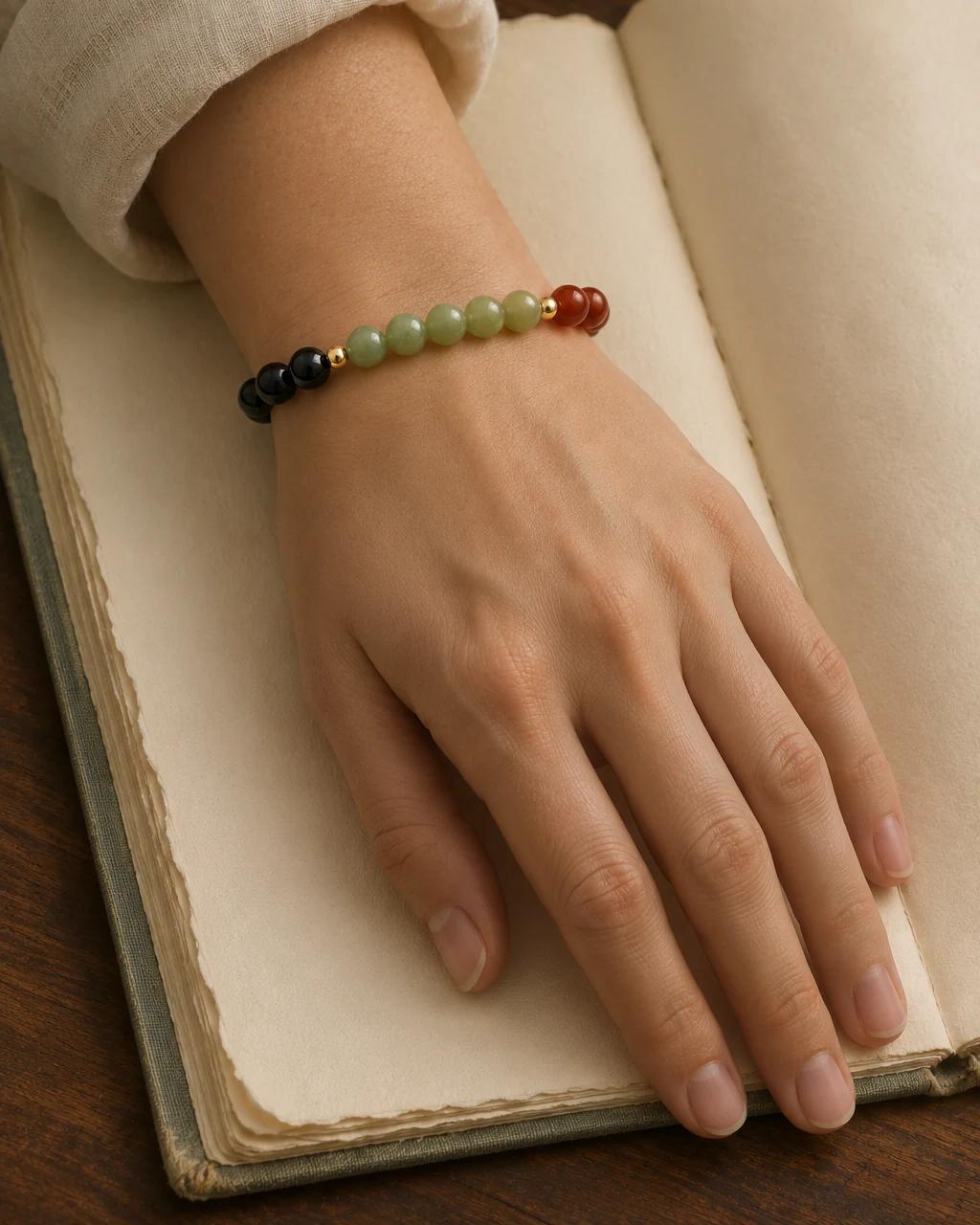
The pieces in our Tao collection keep close to the drawing. The Taiji Inlay Pendant sets black onyx against white mother-of-pearl, divided by a fine S-curve in gold vermeil, with each half carrying a dot of the other material. The Jade Taiji Bracelet is quieter: green nephrite beads and a single gold vermeil taiji bead. Old drawings differ on which way the figure turns and which color sits uppermost, so a pendant that rotates on its chain is not showing the symbol wrongly.
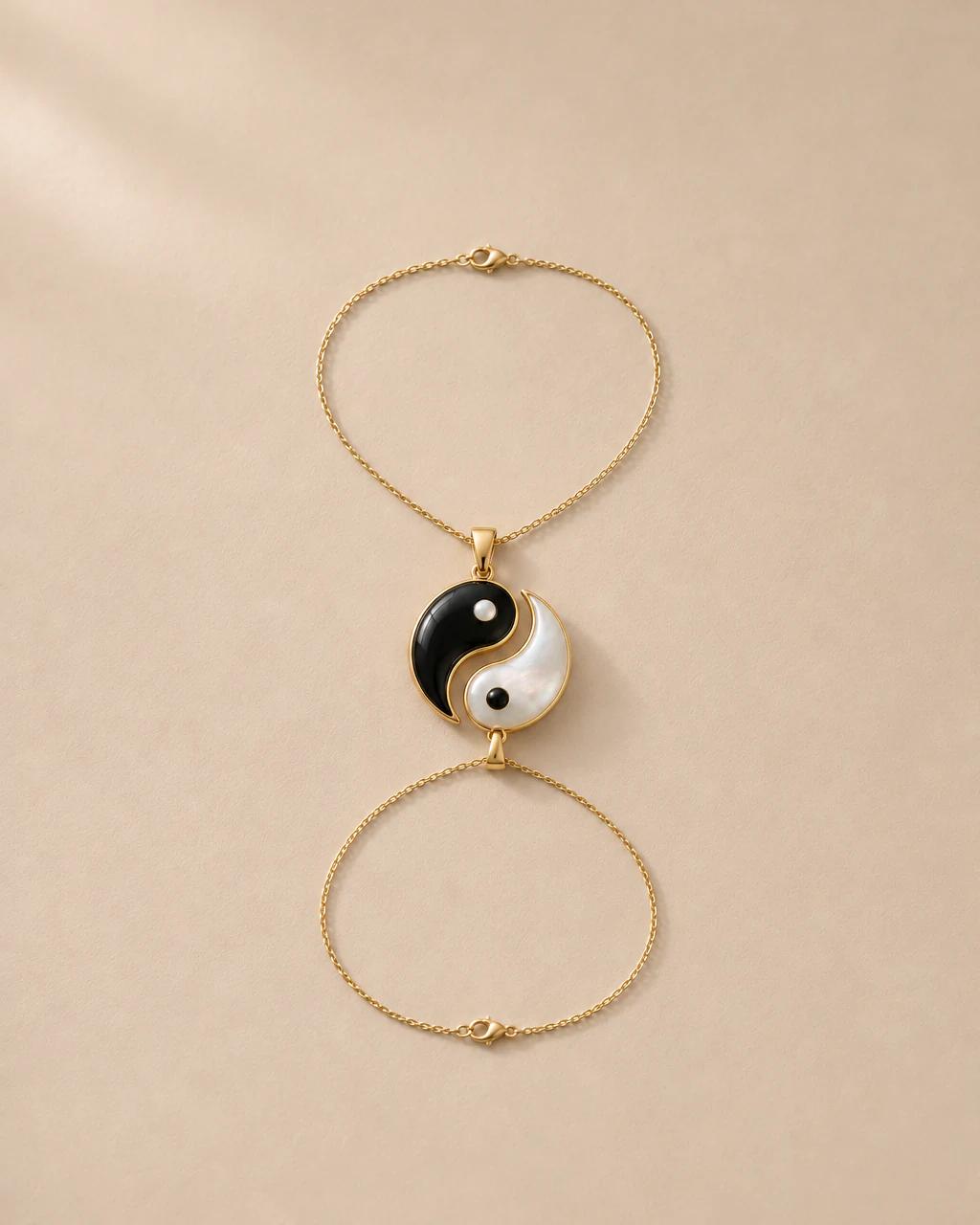
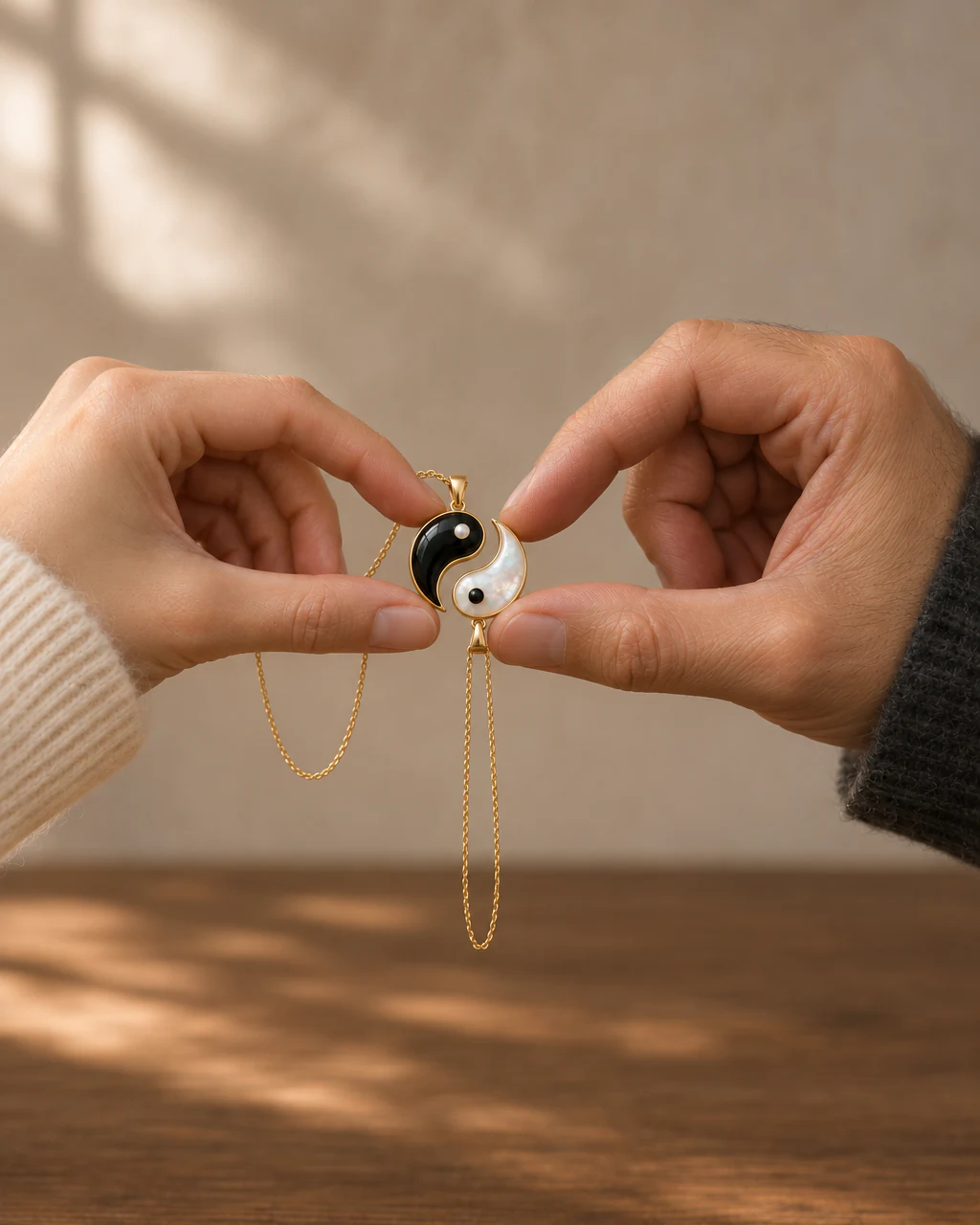
The Two Halves Pair Necklaces divide the circle between two people, one half in onyx and one in mother-of-pearl. That is a modern form, not an old custom. It does follow the logic of the symbol: each half carries a dot of the other, and the circle exists only when the two are brought together.
Either way it is the hillside again. One hill, two slopes, and the light moving across.
Filed under Symbols6 min read